
From sound waves to digital audio: what your microphone records for dictation
How a microphone and your device turn speech into numbers: sample rate, bit depth, mono audio, resampling, and why microphone placement matters more than specs.
In short
Your voice is a pressure wave. The microphone turns it into an electrical signal, and a converter measures that signal thousands of times a second. For speech, 16,000 measurements per second at 16 bits is the classic format. Higher numbers don't guarantee better recognition: a clear voice close to the microphone matters far more than the specs.
You said
running ten minutes late start without me
SayVelio typed
Running 10 minutes late, start without me.
Sound starts as moving air
When you speak, your vocal cords, tongue and lips push air into tiny, fast changes of pressure. A microphone has a thin membrane that moves with those changes and turns the movement into a changing voltage: an analog waveform that mirrors your voice.
Computers can't store a continuous wave, so an analog-to-digital converter (usually built into the laptop, phone or headset) measures it at regular intervals. Each measurement is a sample, stored as a number.
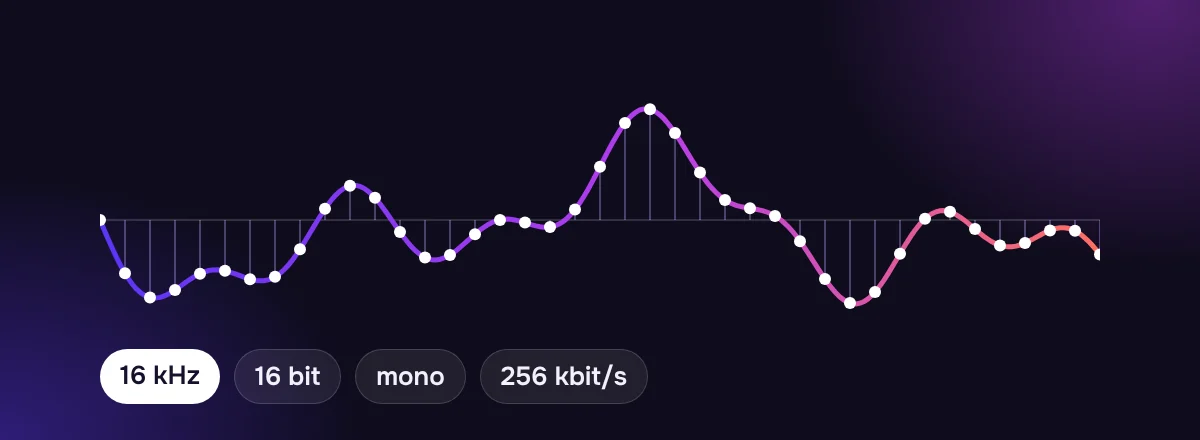
Sample rate: how often the signal is measured
The sample rate is the number of measurements per second. 16,000 Hz (16 kHz) means 16,000 samples every second; 48 kHz means 48,000.
The sample rate sets the highest frequency the recording can hold: roughly half the rate. A 16 kHz recording keeps sounds up to about 8 kHz, which covers what matters for understanding speech. Classic telephone audio keeps only up to about 3.4 kHz, which is why "f" and "s" are so easy to mix up on a call.
Bit depth: how precisely each sample is stored
Bit depth is how many different values each sample can take. Sixteen-bit audio has 65,536 possible levels per sample. That describes the precision of the measurement, nothing more: it doesn't mean a speech model can tell 65,536 kinds of sounds apart.
A dictation recording is usually mono: one channel, one sample per moment. Stereo adds a second channel that rarely helps recognition.
How much data a few seconds of speech is
The arithmetic is simple: 16,000 samples × 16 bits = 256,000 bits per second of mono audio, or 32 KB per second, before any file headers. A 30-second dictation is about 1 MB uncompressed. That's small for a modern connection, but it adds up when an app sends many recordings, which is why some apps compress audio first (see audio compression for speech).
Resampling is more than changing a number
Many microphones record at 48 kHz, while many recognition models expect 16 kHz. Converting between the two isn't just relabeling the file: the audio has to be filtered first to remove frequencies the lower rate can't hold, otherwise they fold back into the recording as distortion (called aliasing). Operating systems and audio libraries do this for you, but it's one more reason not to convert audio back and forth.
The microphone and the room matter most
All of this happens before any recognition, and no software can recover words the microphone never captured clearly. In practice:
- Distance matters most. A headset or the built-in microphone of a laptop in front of you beats a webcam across the room. Far-away microphones pick up more room echo.
- Too close causes pops. Speaking right into a microphone produces bursts of air on "p" and "b" sounds.
- Check which input is selected. If you connect headphones, your computer may switch microphones. On a Mac, check System Settings → Sound → Input; on Windows, Settings → System → Sound.
- Grant microphone permission to the dictation app. Without it, the app receives silence.
Tip
If dictation suddenly gets worse, check the input device first. A switch to a Bluetooth headset's microphone often lowers quality, because many headsets use a narrow, phone-like audio mode while the microphone is in use.
Questions
Does a higher sample rate give better dictation?
Not necessarily. Most speech recognition models work at 16 kHz internally, so a 48 kHz recording is converted down anyway. A clear voice and a good microphone position matter more.
Do I need an external microphone?
Usually not. The built-in microphones of modern laptops and phones are good enough for dictation in a quiet room. A headset helps in open offices or noisy places.
Related reading
 How voice typing works
Preparing your voice for recognition: noise suppression, echo control and voice detection
What happens to audio before speech recognition: gain control, noise suppression, echo cancellation, voice activity detection and spectrograms, and why "cleaner" audio isn't always better.
MacWindowsiPhoneAndroid How voice typing works
Audio formats and compression in voice typing
Digital audio, encoding and compression are three different things. How lossless and lossy compression work, why no algorithm can shrink every file, how speech codecs like Opus trade size against delay, and what that means for dictation.
MacWindowsiPhoneAndroid Getting started
How to dictate well: 9 habits for clean voice typing
How to speak so dictation gets it right the first time: hold the key, say whole thoughts, correct yourself out loud, dictate lists, and what to do when a word comes out wrong.
MacWindowsiPhoneAndroid