
From raw transcript to readable text: punctuation, numbers and cleanup
Why a raw speech transcript isn't ready to send, how punctuation, capitals, numbers and lists get added, why "five fifty" is ambiguous, and how to keep a cleanup step from changing your meaning.
In short
Speech recognition returns your words as you said them: filler words, restarts, no punctuation. A second step turns that into written text: punctuation, capitals, numbers in digits, lists and paragraphs. That step has to interpret, because "five fifty" can be a time, a price or a count. Good cleanup keeps your meaning and your language and only changes the form.
You said
hi sara so the call is at five fifty no sorry six fifteen and the budget is twelve thousand five hundred euros
SayVelio typed
Hi Sara,
The call is at 6:15, and the budget is €12,500.
What a raw transcript looks like
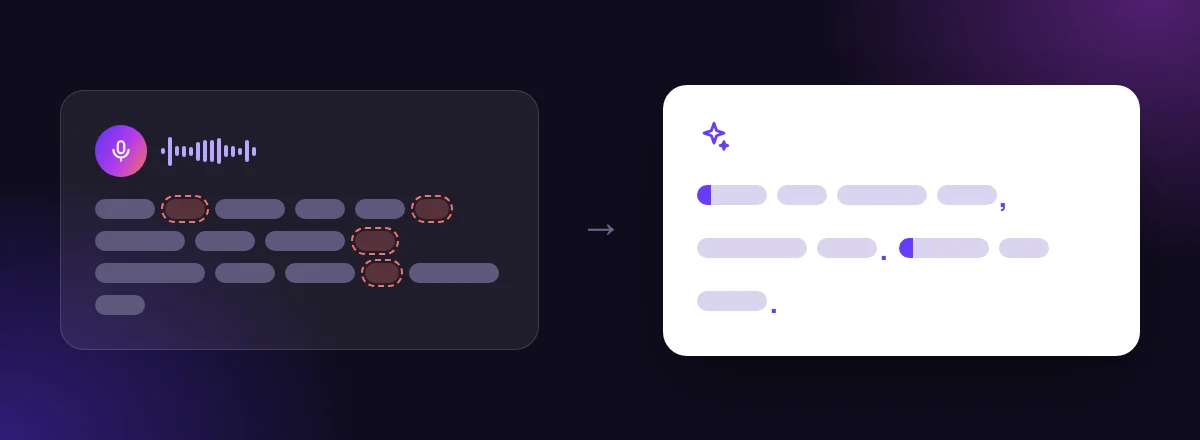
People don't speak in finished sentences. A raw transcript of a normal message often looks like this:
so um the plan is we we send the draft on tuesday no wednesday and then uh anna reviews it
Every word is there, but nobody would send it. Turning it into "The plan: we send the draft on Wednesday, then Anna reviews it." takes several separate decisions: removing "um" and "uh", dropping the repeated "we", applying the self-correction, adding punctuation and capitals.
Punctuation is an interpretation
Microphones don't record commas. Punctuation is inferred from pauses, intonation and sentence structure, so it's an editorial choice, not a measurement. Most of the time it's obvious. Sometimes it changes the meaning ("Let's eat, Grandma" vs "Let's eat Grandma"), which is one reason to read important messages before sending.
Numbers, dates and money: inverse text normalization
Turning spoken forms into written notation has a technical name: inverse text normalization (ITN). It's what turns "one hundred twenty-three dollars" into "$123" and "march third" into "March 3".
It's harder than it looks, because the audio alone often doesn't decide:
| You say | Could be written as |
|---|---|
| "five fifty" | 5:50 (a time), 550 (a number), $5.50 (a price) |
| "twenty twenty-four" | 2024 (a year), 20 24 (two numbers), 20–24 (a range or score) |
| "one oh one" | 101, 1:01 |
| "the third" | 3rd, the 3rd of the month, "the third" (as in the third person) |
Context usually resolves it, and a good cleanup step uses the whole sentence to choose. When precision matters, say a bit more: "five fifty in the afternoon", "five dollars fifty".
The opposite direction, written "$123" to spoken words, is called text normalization and is what text-to-speech systems do; see speech recognition vs text-to-speech.
Words can be right while the format is wrong
Recognition and formatting are different jobs. The recognizer can get every word right, and the result can still be wrong for your purpose: a list written as a paragraph, a time written as a number, a formal email full of exclamation marks. That's the formatting layer's job, and it's where personal settings help.
In SayVelio, this layer is the optional cleanup:
- The cleanup prompt sets the general rules: how to handle lists, numbers, tone.
- App styles adjust the result for where you're typing: short and casual in chat, complete sentences in email, exact commands in a terminal.
- The Fast mode skips cleanup entirely and inserts the transcript as recognized, when you want speed over polish.
Keep a line between "tidier" and "different"
Some changes are harmless: capitals, commas, removing "um". Others change what you said: replacing a name, dropping "not", rounding a number, rephrasing a promise. A good cleanup step makes the first kind freely and avoids the second kind.
SayVelio's cleanup is told to keep your words and your language, never translate and never answer what you dictated. If a result ever looks off, every dictation is kept in History in the app, where you can copy it again.
Questions
Why did a number in my dictation change format?
Cleanup writes spoken numbers the way they're usually written: digits, currencies, times. If it chose the wrong reading, add a word of context when you speak ("at five fifty pm") or describe your preferred formats in your cleanup prompt.
Can I get the text exactly as I said it?
Yes. Use the Fast mode, which inserts what speech recognition heard without cleanup. You'll get your filler words and restarts too.
Related reading
 Features
Cleanup prompts: one main prompt and a style for each app
How SayVelio turns speech into clean text, how to change the main prompt, and how to give email, chats, code and notes their own style, with examples to copy.
MacWindowsAndroid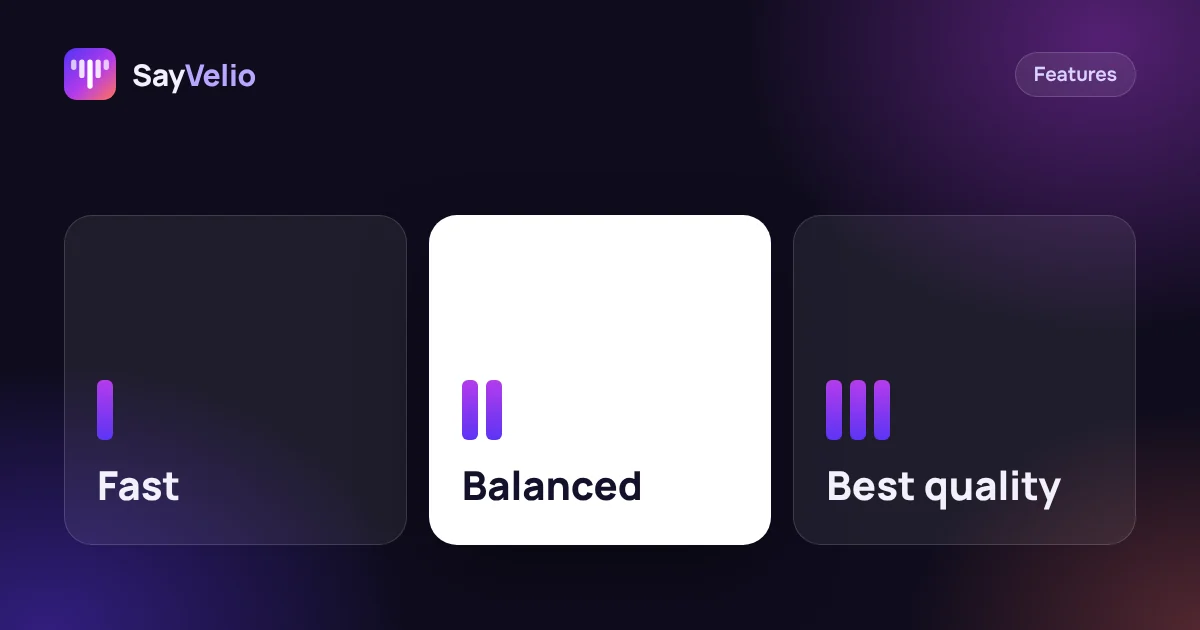 Features
Fast, Balanced or Best quality: which dictation mode to choose
What each SayVelio mode does with your voice, how long it takes, why short phrases skip cleanup, and which mode fits chats, email and long dictations.
MacWindowsiPhoneAndroid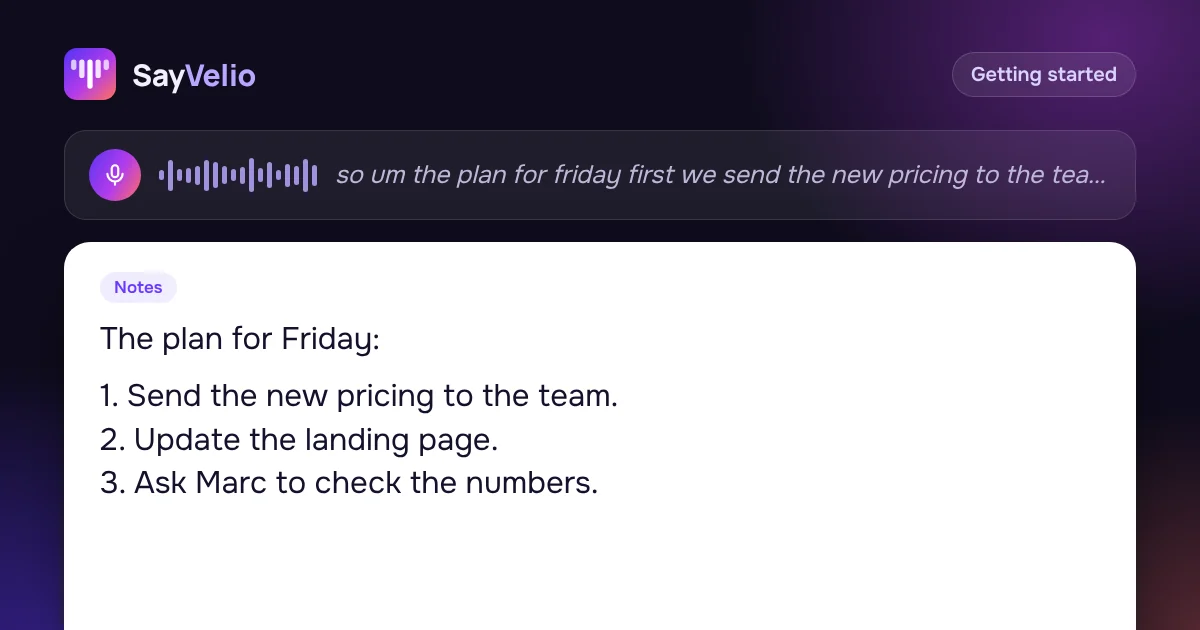 Getting started
How to dictate well: 9 habits for clean voice typing
How to speak so dictation gets it right the first time: hold the key, say whole thoughts, correct yourself out loud, dictate lists, and what to do when a word comes out wrong.
MacWindowsiPhoneAndroid