
Speech recognition vs text-to-speech: what's the difference
Speech recognition turns voice into text; text-to-speech turns text into voice. How each one works, where they meet (numbers, dates, names), how speech codecs differ from both, and why a dictation app doesn't read text aloud.
In short
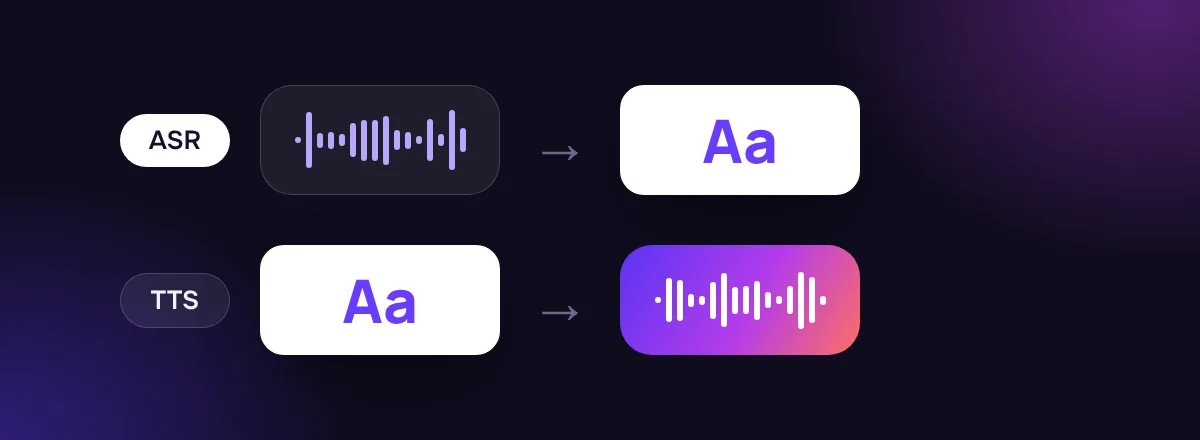
Speech recognition (ASR) listens and writes: audio in, text out. Text-to-speech (TTS) reads and speaks: text in, audio out. They often appear together in voice assistants, but they are separate technologies with different training, outputs and quality measures. A third technology, the speech codec, only shrinks audio for sending and does neither.
You said
the meeting moved to three thirty on the twelfth
SayVelio typed
The meeting moved to 3:30 on the 12th.
Opposite directions
| Speech recognition (ASR) | Text-to-speech (TTS) | Speech codec | |
|---|---|---|---|
| Input | Audio of someone speaking | Written text | Audio |
| Output | Text | Synthetic speech audio | The same audio, smaller |
| Main question | Which words were said? | How should this text sound? | How to send this sound efficiently? |
| Typical use | Dictation, captions, voice search | Screen readers, navigation, audiobooks | Calls, voice messages |
| Quality measured by | Word error rate | Naturalness and intelligibility ratings | Listening tests at a given bitrate |
A voice assistant uses both: recognition to understand your question, synthesis to answer out loud. But one doesn't imply the other. SayVelio is a dictation app: it recognizes speech and writes text, and it doesn't read anything aloud.
How text-to-speech works
A typical TTS system works in stages:
- Text analysis. Expand abbreviations and numbers into words ("Dr." → "doctor" or "drive"?), and pick the right pronunciation for words spelled the same but said differently ("read" in the past or present tense).
- Prosody. Decide rhythm, pauses, emphasis and pitch, so a question sounds like a question.
- Acoustic model. Predict how the speech should sound over time, often as a spectrogram.
- Vocoder. Turn that prediction into an actual waveform you can play.
A well-known example is Google's Tacotron 2 (2018), which predicts a mel spectrogram from text and uses a neural vocoder to produce the audio. Many newer systems merge or reorder these stages, but the job of each remains.
Developers can steer TTS with SSML (Speech Synthesis Markup Language), a W3C standard for marking pauses, emphasis, pronunciation and how to read things like dates. Support for individual SSML features varies between engines.
Where the two meet: numbers, dates and names
Both directions struggle with the same things, from opposite sides:
- Dictation has to turn spoken "twelve fifty" into written form: 12:50? 1250? $12.50? That's inverse text normalization, described in from transcript to text.
- Text-to-speech has to turn written "12/05" into speech: December fifth or the twelfth of May? That's text normalization.
The two are related but not exact mirror images, because the right answer depends on context in both directions. Names are hard both ways too: a recognizer needs to know how to spell a name it hears (that's what a dictionary is for), and a synthesizer needs to know how to say a name it reads.
Codecs are a third, separate thing
A speech codec, such as Opus, represents audio that already exists in fewer bits so it can be sent or stored. It doesn't create speech from text and doesn't decide which words someone said. A product that transcribes speech doesn't have to synthesize speech or use any particular codec. More in audio compression for speech.
Both use machine learning, differently
Modern ASR and TTS are both built with neural networks, and both learn from paired audio and text. But their goals are opposite: ASR is judged on whether it got the words right, TTS on whether people find the voice natural and easy to understand. A model that's excellent at one doesn't automatically do the other.
Questions
Can SayVelio read my text back to me?
No. SayVelio is for writing by voice. To have text read aloud, use your system's built-in feature: Spoken Content on Mac and iPhone, Narrator on Windows, Select to Speak on Android.
Is "speech to text" the same as "voice recognition"?
Usually people mean the same thing, but strictly speaking voice recognition can also mean recognizing who is speaking. SayVelio recognizes what you say, not who you are.
Related reading
 How voice typing works
How speech recognition turns sound into words
Why speech is hard for computers, how classic recognizers with acoustic, pronunciation and language models worked, what end-to-end models (CTC, encoder-decoder, transducers) changed, and why streaming text can change while you speak.
MacWindowsiPhoneAndroid How voice typing works
From raw transcript to readable text: punctuation, numbers and cleanup
Why a raw speech transcript isn't ready to send, how punctuation, capitals, numbers and lists get added, why "five fifty" is ambiguous, and how to keep a cleanup step from changing your meaning.
MacWindowsiPhoneAndroid How voice typing works
Audio formats and compression in voice typing
Digital audio, encoding and compression are three different things. How lossless and lossy compression work, why no algorithm can shrink every file, how speech codecs like Opus trade size against delay, and what that means for dictation.
MacWindowsiPhoneAndroid