
How accurate is voice typing? Word error rate, speed and real limits
How speech recognition accuracy is measured (word error rate), what research says about dictation vs typing speed, what makes results worse, and which words you should always double-check.
In short
Accuracy is usually measured as word error rate: substituted, deleted and inserted words divided by the words actually said. It's useful but narrow: it ignores punctuation, formatting and meaning. Research shows speaking is roughly three times faster than typing on a phone. Errors cluster around names, numbers and noise, so those are the words to check before you send.
You said
please transfer fifteen hundred not five thousand to the supplier account
SayVelio typed
Please transfer 1,500, not 5,000, to the supplier account.
Three kinds of mistakes
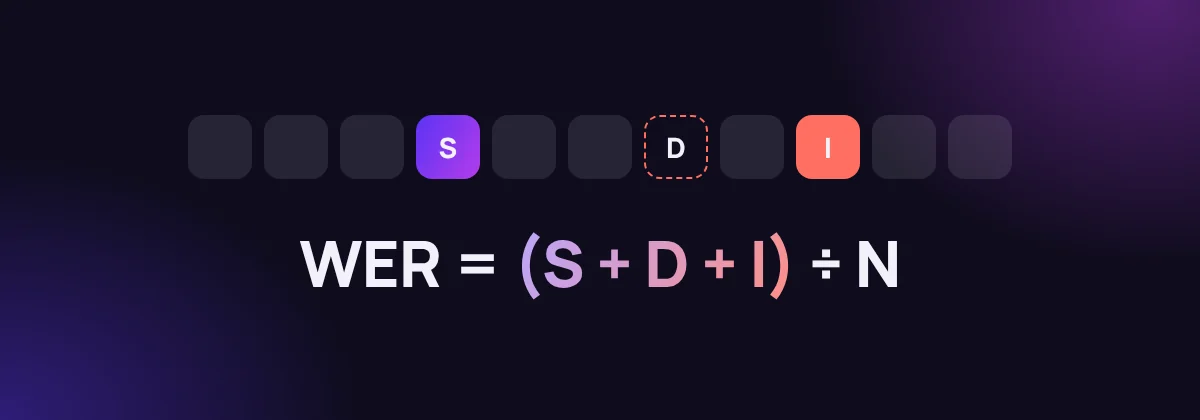
When a recognizer gets something wrong, it does one of three things:
- Substitution: a word is replaced by another ("fifteen" → "fifty").
- Deletion: a word goes missing ("not" disappears).
- Insertion: a word appears that wasn't said.
Word error rate (WER)
The standard measure counts those three against a correct reference transcript:
WER = (substitutions + deletions + insertions) ÷ number of words in the reference
An example. The reference has 10 words: "please send the final report to Maria before Friday morning". The system writes "please send the file report to Mario before Friday morning": 2 substitutions, 0 deletions, 0 insertions. WER = 2 ÷ 10 = 20%.
What WER doesn't tell you
WER is a good engineering measure and a poor summary of user experience:
- All words count the same. Missing "the" and missing "not" both cost one error, though only one flips the meaning.
- It depends on scoring rules. Is "5" vs "five" an error? Is "OK" vs "okay"? Results change with how text is normalized before comparing.
- It ignores punctuation and formatting, the part handled by the cleanup step.
- It's tied to its test set. A low WER on clean read speech says little about your accent, your microphone or your industry's vocabulary.
So when two products are compared, the comparison means something only with the same audio, the same language, the same task and the same scoring rules. A brand name or a marketing speed claim isn't a substitute for that.
How fast is dictation compared with typing?
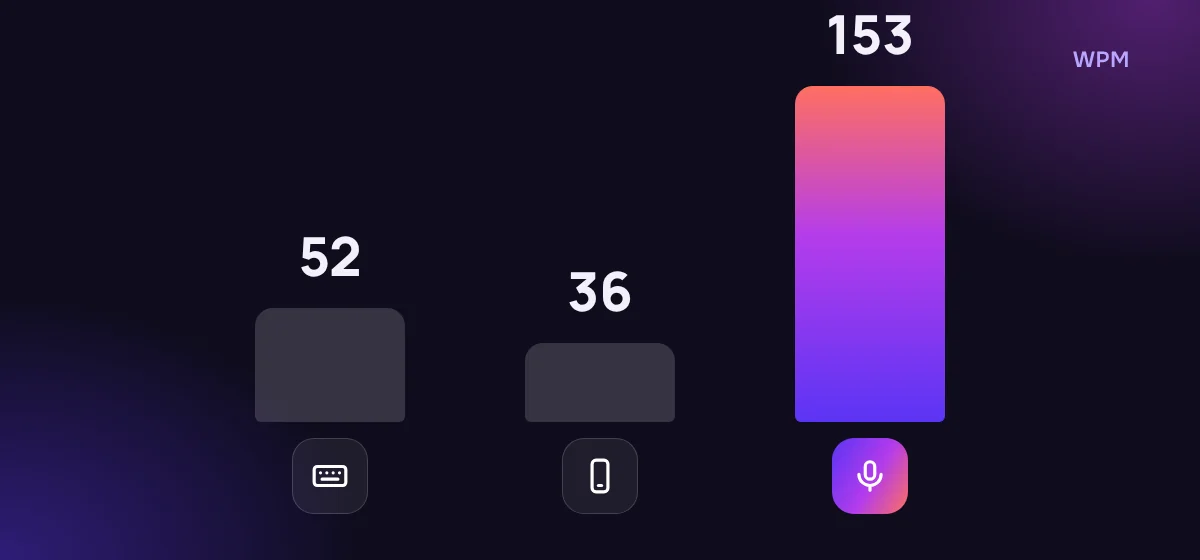
Here's what peer-reviewed studies found:
| Input method | Average speed | Study |
|---|---|---|
| Physical keyboard | 52 words per minute | Dhakal et al., CHI 2018, 168,000 volunteers |
| Phone on-screen keyboard | 36.2 words per minute | Palin et al., MobileHCI 2019, 37,370 volunteers |
| Speech on a phone (English) | 153 words per minute | Ruan et al., 2017, short messages in a lab |
| Phone keyboard in the same lab study | 52 words per minute | Ruan et al., 2017 |
In the Stanford study by Ruan and colleagues, speech was 2.93 times faster than the phone keyboard in English and 2.87 times faster in Mandarin Chinese, and people had to fix fewer mistakes along the way (a corrected error rate of 5.3% vs 11.2% in English), though slightly more errors were left in the final speech text (1.3% vs 0.8%). The studies used different tasks and people, so treat the comparison as a rough picture rather than a precise ratio. In real work you also spend time thinking and reviewing, so the everyday gain is smaller than in a lab, but it's still large for longer messages.
What makes results worse
- Noise and echo: background voices, distant microphones, big rooms (see noise suppression and voice detection).
- Several speakers talking over each other.
- Clipped audio: speaking so close or so loud that the signal distorts.
- Unfamiliar names and jargon, which the model has rarely seen (see how context helps recognition).
- Switching languages mid-sentence, which some systems handle poorly.
Speed has a cost too
Total waiting time is the sum of several parts: finishing the recording, sending it, recognition, optional cleanup and inserting the text. Streaming systems also have to decide how soon to commit to words, trading early text against later corrections. In SayVelio, the dictation modes let you choose: Fast inserts the recognized text without cleanup, Balanced and Best quality add cleanup for more polished text.
Always check these before sending
For text that matters, you are the final reviewer. Look twice at:
- numbers and amounts, including currency and decimals;
- names of people, companies and products;
- negations: "not", "no", "never", "can't";
- dates and times;
- medical, legal and financial instructions;
- anything a cleanup step may have rephrased.
Easy correction makes dictation useful even when it isn't perfect, but convenience is not proof that no error happened.
Sources
- Dhakal, V., Feit, A. M., Kristensson, P. O., Oulasvirta, A. Observations on Typing from 136 Million Keystrokes. CHI 2018. University of Cambridge summary
- Palin, K., Feit, A. M., Kim, S., Kristensson, P. O., Oulasvirta, A. How do People Type on Mobile Devices? Observations from a Study with 37,000 Volunteers. MobileHCI 2019. Project page
- Ruan, S., Wobbrock, J. O., Liou, K., Ng, A., Landay, J. A. Comparing Speech and Keyboard Text Entry for Short Messages in Two Languages on Touchscreen Phones. Proceedings of the ACM on Interactive, Mobile, Wearable and Ubiquitous Technologies, 2017. arXiv:1608.07323
Questions
What is a good word error rate?
It depends on the audio and the task. Clear dictation in a quiet room with a modern model often has a low single-digit WER, while noisy, multi-speaker recordings can be much higher. Compare systems only on the same audio and scoring rules.
Can WER be higher than 100%?
Yes. Insertions are counted too, so a system that adds lots of words that weren't said can make more errors than there were words.
Related reading
 Getting started
How to dictate well: 9 habits for clean voice typing
How to speak so dictation gets it right the first time: hold the key, say whole thoughts, correct yourself out loud, dictate lists, and what to do when a word comes out wrong.
MacWindowsiPhoneAndroid Features
Custom dictionary: teach dictation your names, brands and jargon
What to add to your SayVelio dictionary and what to leave out, how to fix a word that keeps coming out wrong, and why a short dictionary beats a long one.
MacWindowsiPhoneAndroid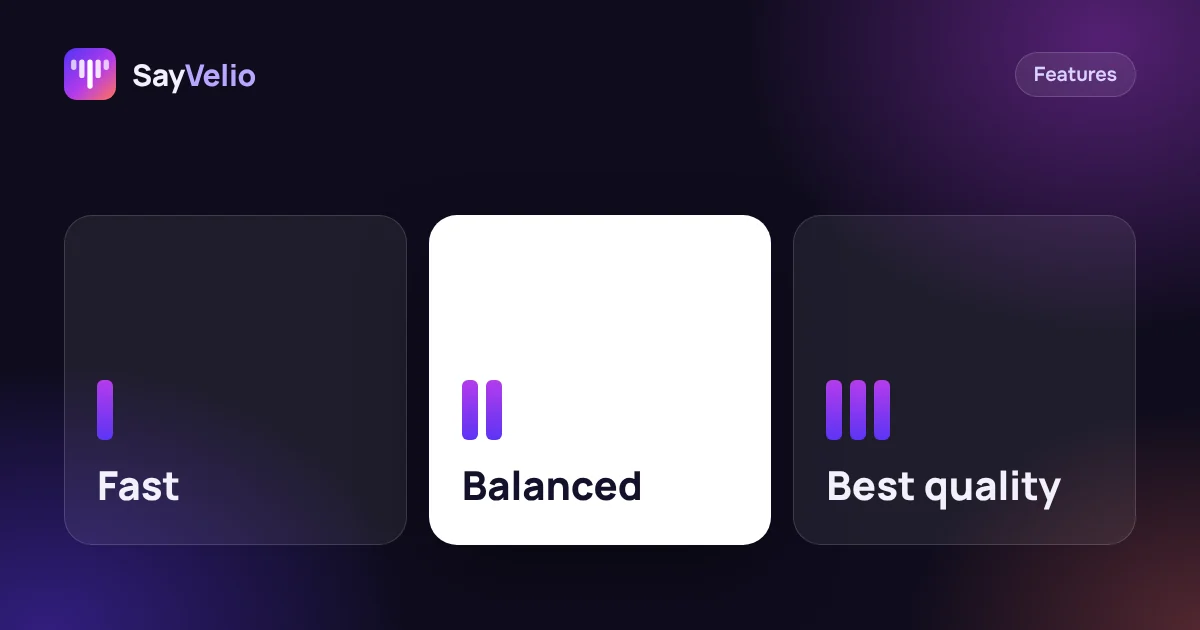 Features
Fast, Balanced or Best quality: which dictation mode to choose
What each SayVelio mode does with your voice, how long it takes, why short phrases skip cleanup, and which mode fits chats, email and long dictations.
MacWindowsiPhoneAndroid