
How speech recognition learns, and why context helps with names and jargon
Training vs everyday use, why models struggle with unfamiliar names and accents, how context hints and dictionaries steer recognition, and why dictating doesn't mean your voice trains the model.
In short
A speech model learns from huge amounts of recorded speech paired with text, then applies what it learned to your voice. It is best at what it saw often and weakest at rare names and jargon. A context hint, like the words in your dictionary, tilts recognition toward your terms without changing the model itself, and using a hint doesn't mean your recordings become training data.
You said
can you push the hotfix to kubernetes before the demo with acme
SayVelio typed
Can you push the hotfix to Kubernetes before the demo with Acme?
Training and use are two different moments
Machine learning lets a model find patterns from examples instead of following hand-written rules. For speech, those examples are recordings paired with what was said. Training adjusts the model's internal parameters across a huge number of such examples. Inference is what happens when you dictate: the finished model is applied to your new recording.
The two are separate. Dictating a sentence doesn't by itself teach the model anything. Whether a provider ever uses customer audio for training is a policy question, not a technical necessity. SayVelio doesn't train AI on your data; see privacy in voice typing.
What a model is good at, and where it struggles
A model reflects what it was trained on. A common word said clearly in a quiet room is easy. Things get harder when your audio differs from the training data:
- Rare words: surnames, product names, internal project names, new slang.
- Accents and speaking styles that were less common in the training data.
- Conditions: echo, distant microphones, several people talking.
- Mixed languages within one sentence, which SayVelio handles by detecting the language on every dictation (see dictating in two languages).
That's why quality has to be measured on recordings the model never saw during training. A model that looks perfect on its own training data can still stumble on your voice.
More data isn't automatically better
It's easy to assume that more features, more measurements or more parameters always mean better results. In practice, irrelevant or redundant information can make a model learn noise instead of patterns that generalize. Researchers test models on held-out recordings precisely to check whether an improvement survives on new speech. For you, only one number matters: how well it transcribes your next sentence.
Two ways to fix a stubborn word
| Context hint | Fine-tuning | |
|---|---|---|
| What changes | Which candidate words are favored for this request | The model's parameters, through extra training |
| How fast | Instantly, per dictation | Takes training data and time |
| Who does it | You, by adding words | The model provider |
| Guarantee | None, but very effective for names | None either |
A context hint is like telling a person before a meeting: "you'll hear the names Kubernetes and Acme". It doesn't change their hearing, it changes their expectations.
How SayVelio uses your dictionary
Your SayVelio dictionary works as that kind of hint at two points:
- During recognition, your words are passed to the speech model as context, so it's more likely to choose them when the sound fits.
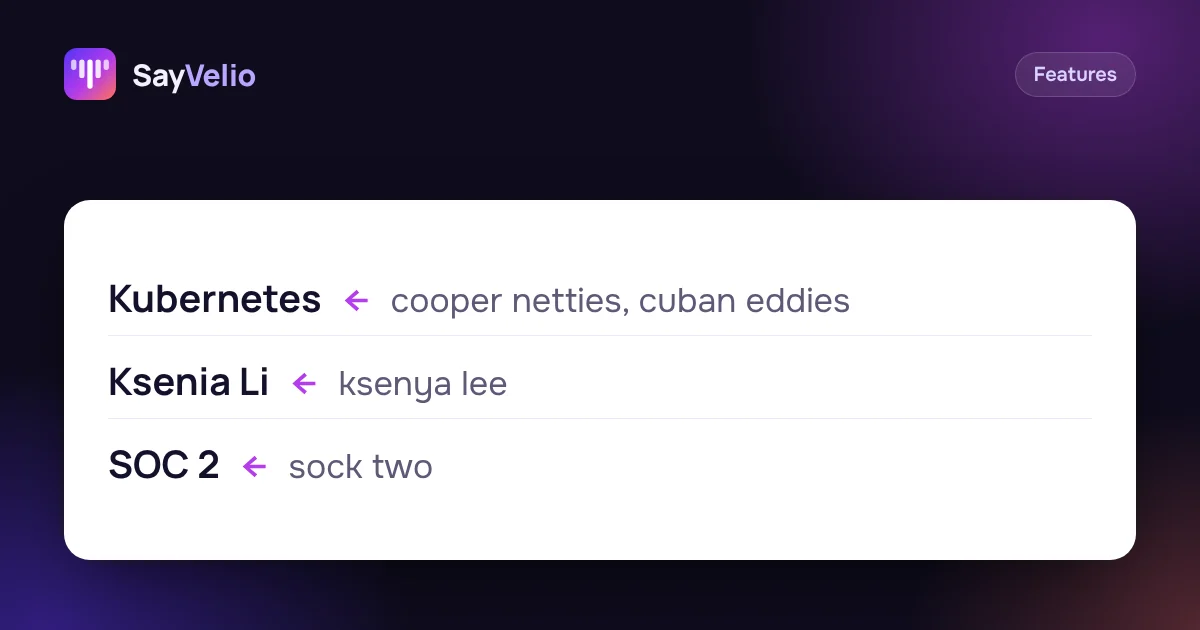
- During cleanup, if it's on, the dictionary helps fix spellings that recognition still got wrong, including the variants you listed for how a word sounds.
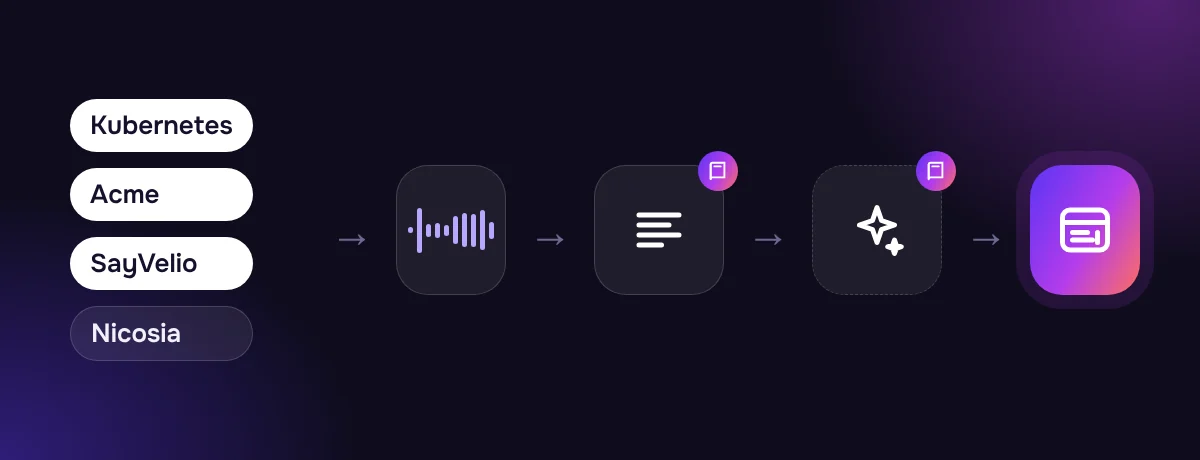
Neither step is a guarantee, and a short, focused dictionary works better than a long one, because hundreds of hints dilute each other. Add the words that actually come out wrong, and let unused ones drop off.
Cleanup is a second model, with its own risks
Recognition writes down words; an optional cleanup step rewrites them into readable text. Cleanup uses a language model, which is great at punctuation and removing "um"s, but a model that rewrites too freely can also change meaning. SayVelio's cleanup is instructed to keep your words and your language, never translate and never answer what you said. Still, for anything important, compare the result with what you meant.
Questions
Does SayVelio learn my voice over time?
No. The recognition model doesn't adapt to your voice, and your recordings are not used for training. What adapts to you is your dictionary, your cleanup prompt and your app styles.
Why does adding a word not always fix it?
A hint makes a word more likely, it doesn't force it. If the word still comes out wrong, add how it sounds as a variant, or check that the word isn't drowned out by a very long dictionary.
Related reading
 Features
Custom dictionary: teach dictation your names, brands and jargon
What to add to your SayVelio dictionary and what to leave out, how to fix a word that keeps coming out wrong, and why a short dictionary beats a long one.
MacWindowsiPhoneAndroid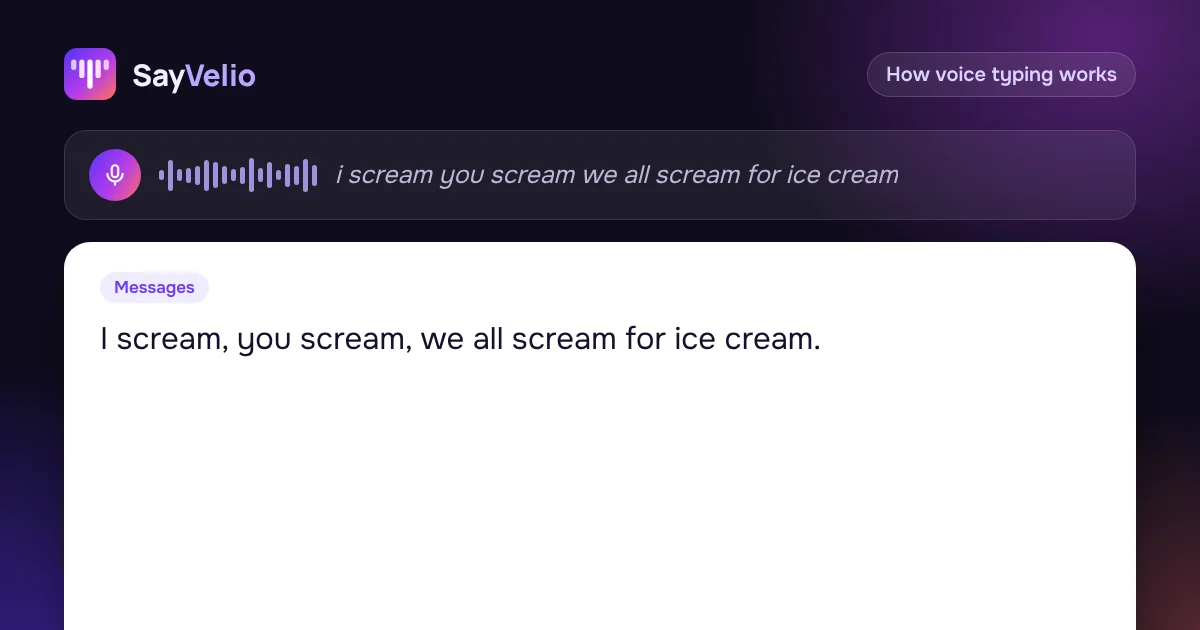 How voice typing works
How speech recognition turns sound into words
Why speech is hard for computers, how classic recognizers with acoustic, pronunciation and language models worked, what end-to-end models (CTC, encoder-decoder, transducers) changed, and why streaming text can change while you speak.
MacWindowsiPhoneAndroid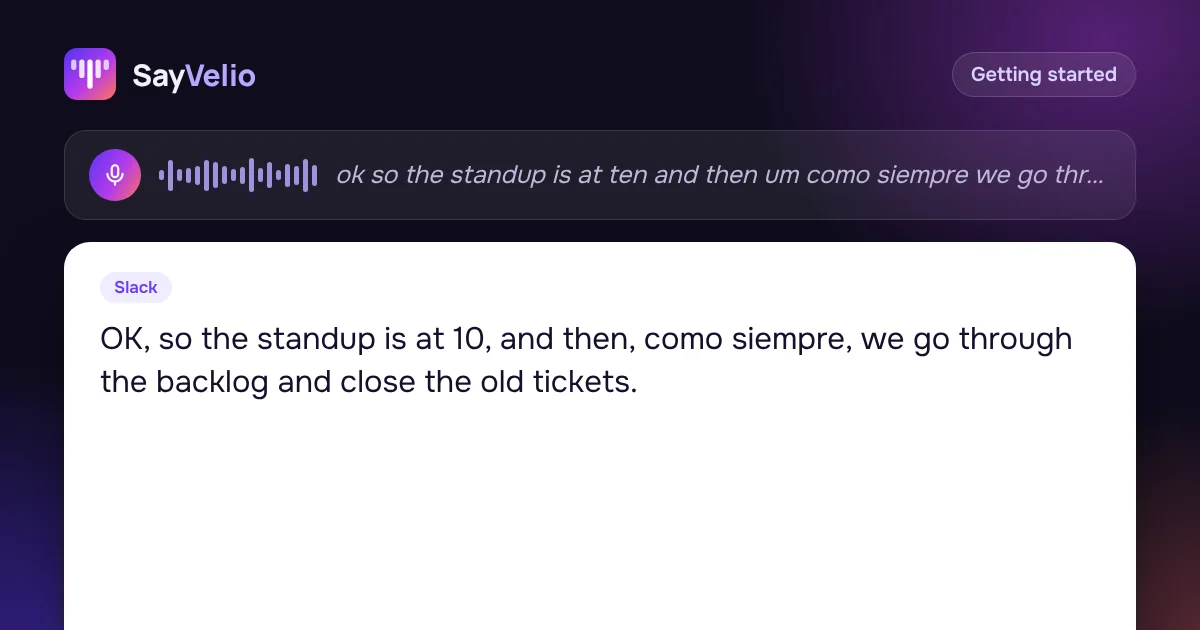 Getting started
Dictating in two languages: mix English terms into your own language
How SayVelio handles bilingual speech: language detection on every dictation, English terms kept as they are, no translation, and how the dictionary and app styles keep mixed text right.
MacWindowsiPhoneAndroid